Going back to the 1970s or 1980s might not sound particularly sexy to Gordon Ramsay, but sometimes that’s exactly what you want from a restaurant.
Modern places are everywhere these days, often serving more or less the same internationalized food. But what if you actually want to taste the authentic, home-style cooking of a country—in this case, Denmark?
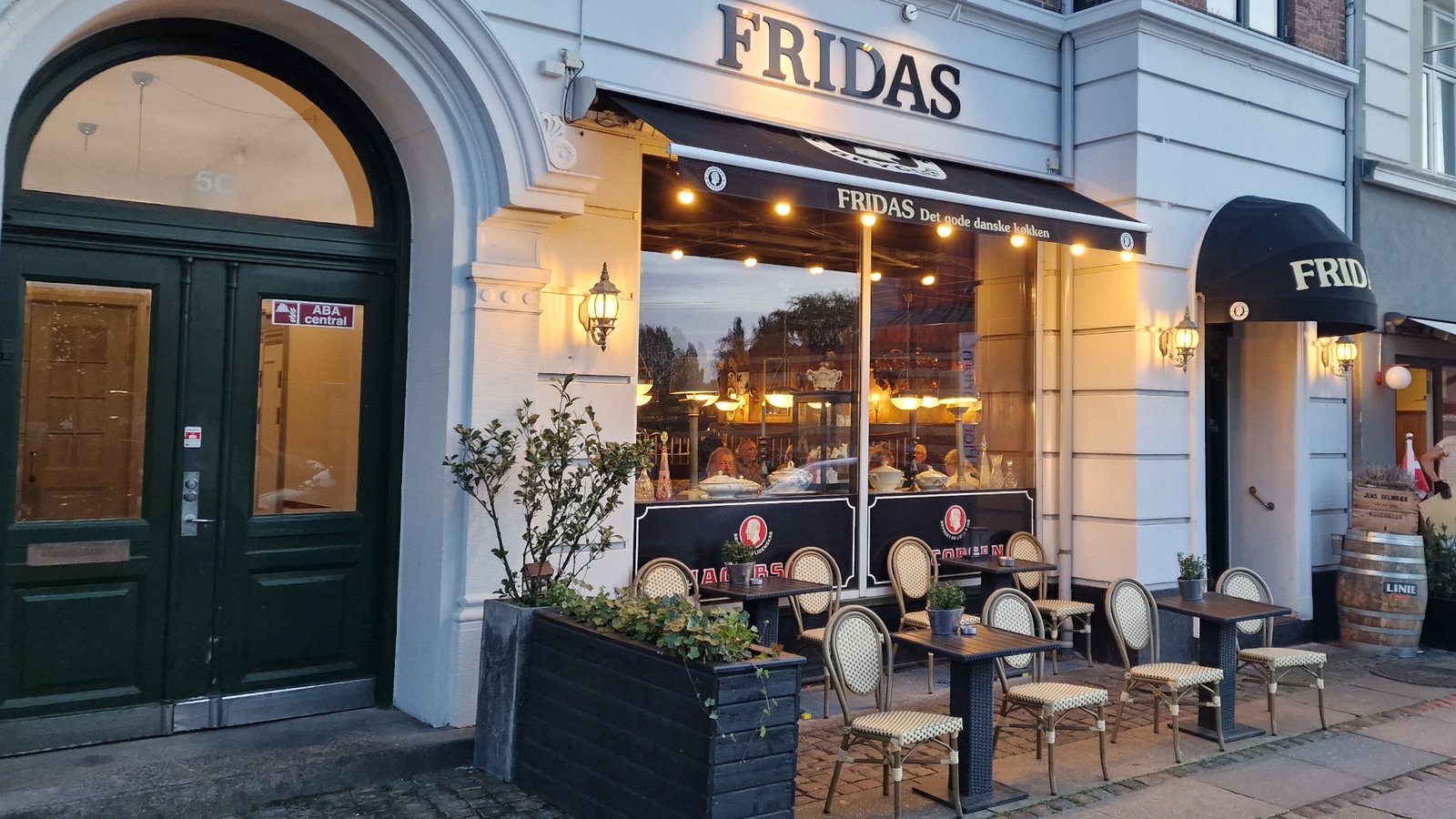
Fridas in Copenhagen is one of those increasingly rare places where you can still do exactly that, and in an environment that feels just as traditional as the food itself.
I had been eyeing the restaurant for quite some time. Its location is almost suspiciously convenient, practically in the city center—or at least right next to what most tourists think of as central Copenhagen.
And I’m always a little suspicious of traditional restaurants in heavily visited parts of a city. Too often, they seem less interested in showing you what locals actually eat and more interested in selling tourists some vaguely “authentic” version of it.
Fridas turned out to be almost the exact opposite.
Stepping Back in Time
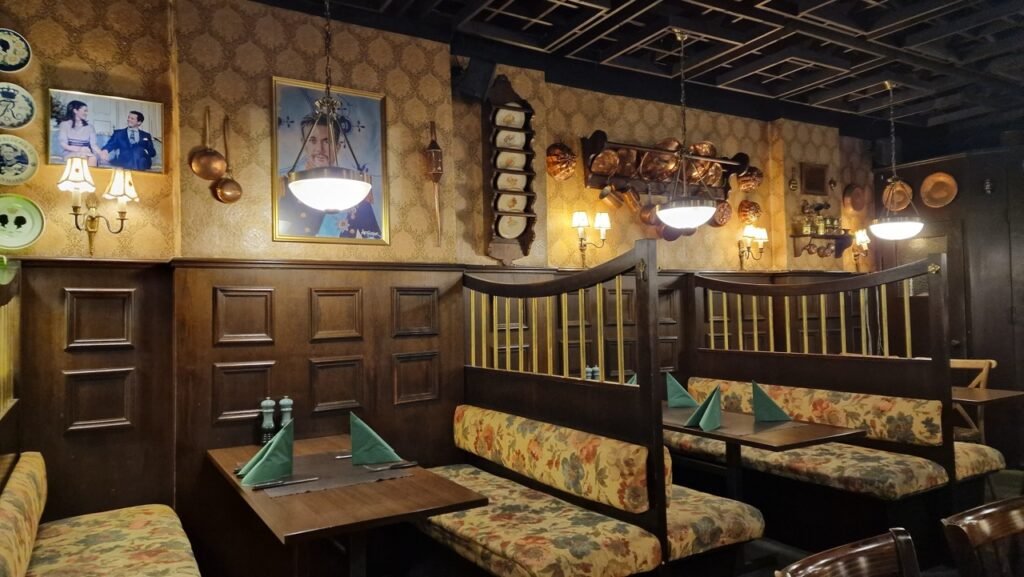
Walking into Fridas feels a little like stepping several decades back in time.
Dark wood paneling, floral upholstered benches, old-fashioned lamps, copper pots and pans on the walls, royal memorabilia—the whole place has a strong 1970s or 1980s feeling. And importantly, it doesn’t look like someone recently spent a fortune designing a trendy retro restaurant. It simply feels genuinely old-school.
There was another detail that made the time-travel experience even stronger when we arrived relatively early in the evening. Let’s just say that even at 50, we initially felt remarkably young compared with most of the other guests.
There is absolutely nothing wrong with that, of course. It was just another one of those little moments when you look around and wonder whether you have somehow traveled back in time.
But even that changed as the evening went on. The earlier guests gradually left, new groups arrived, and the crowd became noticeably younger. So it would be completely unfair to describe Fridas as a restaurant for older people.
What remained unchanged was something much more important.
So, Is Fridas a Tourist Trap?
Almost everyone around us was speaking Danish.
And that immediately killed most of my suspicion.
There were couples, groups of four, and much larger parties sitting around us, talking, eating, and clearly having a good time. The waiters kept carrying out traditional-looking Danish dishes, and everything about the place suggested that these weren’t tourists who had wandered in looking for “something Danish.”
These were locals having dinner.
Even as the crowd changed throughout the evening, this remained true. Apart from us, I noticed perhaps one other group where someone was speaking English. Otherwise, Danish was what we heard all around us.
That doesn’t mean Fridas is difficult for tourists to visit. Quite the opposite.
Both waiters who served us were extremely friendly and, as is usually the case in Denmark, spoke excellent English. The menu also included English descriptions underneath the dishes, so at no point did we feel like outsiders or like we had accidentally entered somewhere we weren’t supposed to be.
And I think that distinction is important.
Fridas is not a restaurant created for tourists. It’s a restaurant for locals where tourists are very welcome.
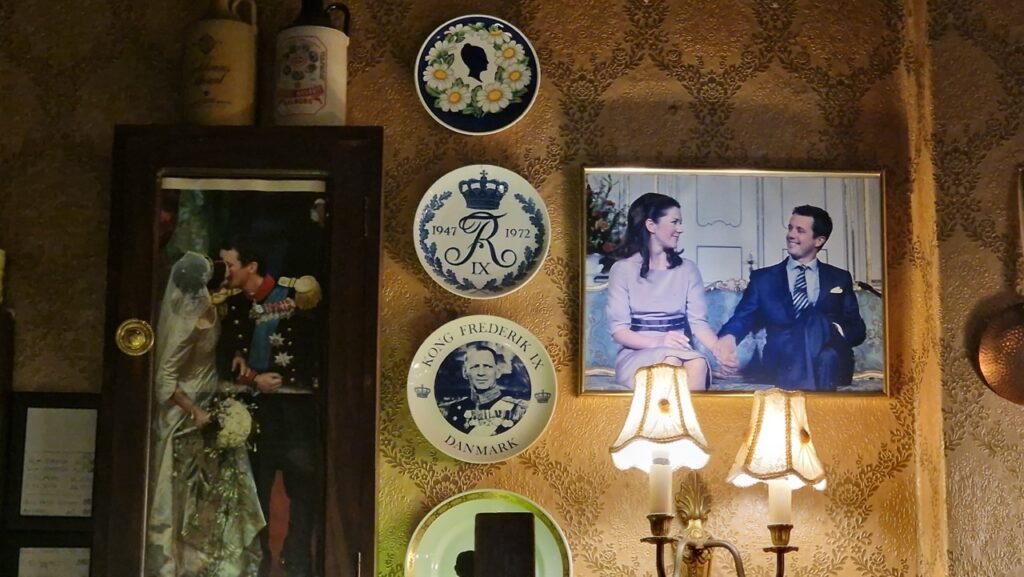
If you come to Copenhagen specifically wanting to taste traditional Danish food in a place where Danes themselves still eat it, that makes Fridas particularly interesting.
What We Came For: Stegt Flæsk med Persillesovs
There was one dish in particular we came to Fridas to try: stegt flæsk med persillesovs.
I had actually made it myself not long before this visit, so I was especially curious to see how it would compare with the version served at a genuinely traditional Danish restaurant. Click the link in the previous paragraph to see my recipe!
Stegt flæsk med persillesovs is about as straightforward as Danish comfort food gets. Thick slices of pork belly are fried until well browned and crispy, then served with boiled potatoes and parsley sauce. It is often referred to as Denmark’s national dish, and it is still something Danes genuinely eat today.
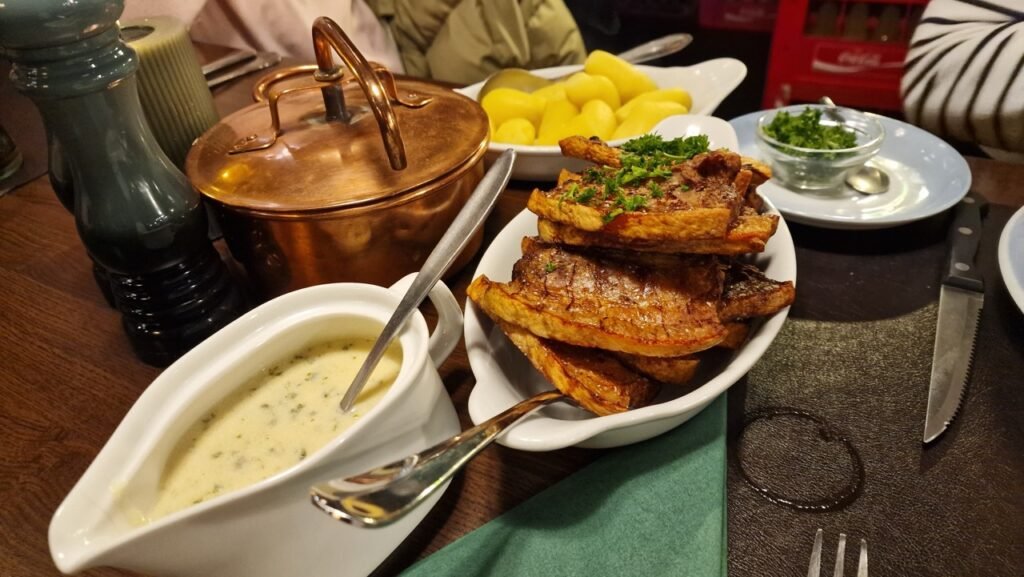
This is not sophisticated food. There are no exotic spices, no elaborate plating, and no huge list of ingredients.
But that is exactly why I think it is worth trying.
Getting to know another country’s food culture doesn’t only mean looking for spectacular or heavily seasoned dishes. Sometimes a simple combination of meat, potatoes, and sauce tells you much more about what people actually eat.
And if you enjoy roast meat and simple but distinct flavors, stegt flæsk is a pretty difficult dish not to like.
How Was the Stegt Flæsk?
First of all, there was a lot of it.
The huge platter of pork that arrived at our table looked as if it could easily have fed three people, possibly four less determined ones. We had ordered for two.
The pork itself was cooked exactly the way this dish is supposed to be. Even though it comes from pork belly, the final result is relatively dry rather than juicy, with much of the fat rendered out and the exterior becoming wonderfully crisp.
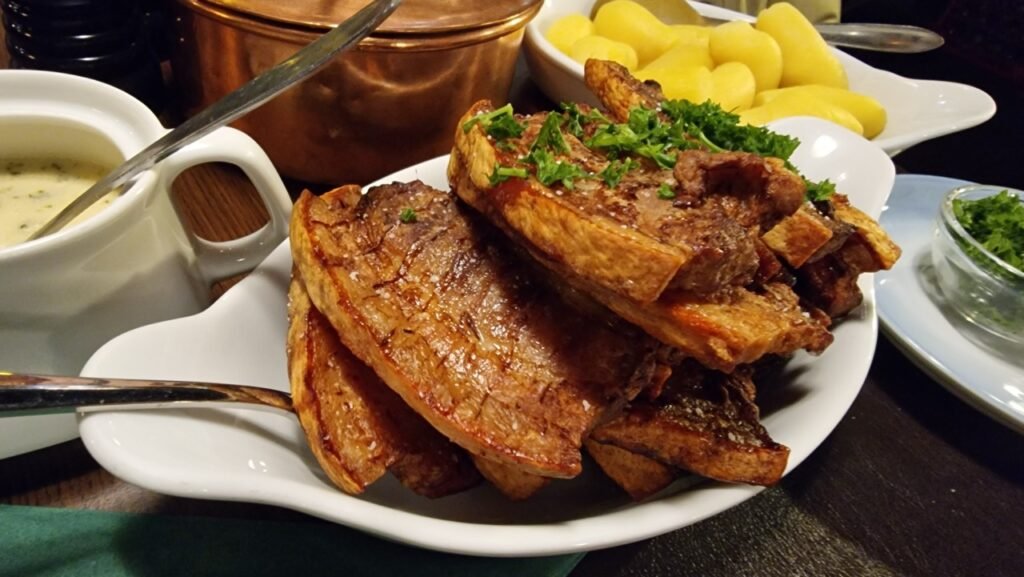
That includes the rind.
At one point, our waiter actually noticed that we had left some of the crispiest pieces behind and basically told us off for it.
“Why weren’t you eating them? That’s the best part.“
She then explained that Danes eat pork crackling as a snack as well and even pointed out that they sold packaged pieces at the restaurant.
Fair enough. We got the message.
The potatoes were equally simple and equally good. They appeared to have been boiled in their skins and peeled afterward, and there really isn’t much more you need to say about a good boiled potato.
Then came the persillesovs, or Danish parsley sauce (click for the recipe).
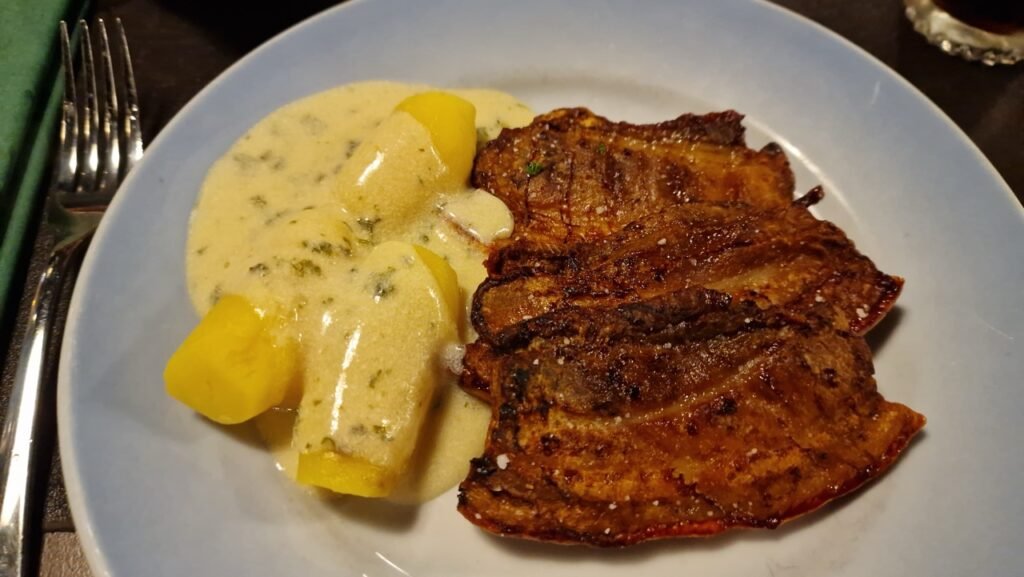
It is basically a simple white sauce, similar to béchamel, flavored with chopped parsley. Fridas used noticeably less parsley than I tend to use when I make it myself. Personally, I prefer it with more, but that’s purely a matter of taste.
Together, though, everything worked. Crispy salty pork, mild potatoes, and creamy parsley sauce.
Gammeldags Æblekage – Straight Back to the 1980s
Despite the amount of pork we had just eaten, I still ordered dessert. Strictly for research purposes, obviously.
I went for gammeldags æblekage, which literally means old-fashioned apple cake.
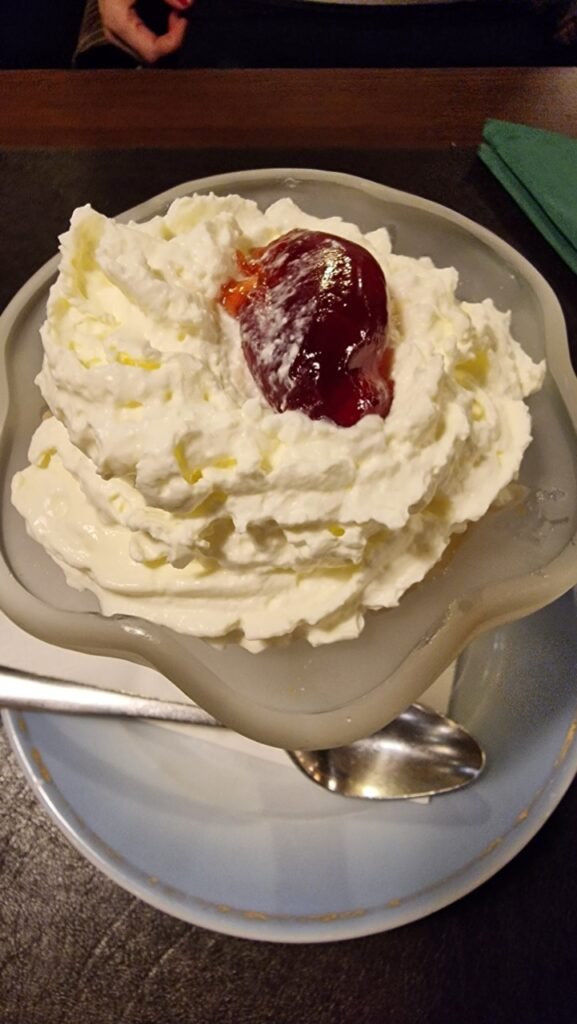
The funny thing is that it isn’t really a cake in the way most English speakers would imagine one.
It arrived cold in a chilled dessert glass, with apple compote, a crumb-like layer with a very pronounced almond flavor, and an almost absurd amount of whipped cream piled on top. There was also a spoonful of berry jam on top.
And this was probably the moment when Gordon Ramsay would have finally lost patience and reminded everyone that it is no longer 1987.
But that would completely miss the point.
Fridas is not trying to be a modern restaurant. It isn’t trying to reinvent Danish classics, reduce everything to three artistic dots on an oversized plate, or serve the same internationalized food you can increasingly find in almost every major city.
This dessert looked old-fashioned because it was old-fashioned.
And that was precisely why I wanted to try it.
As for the taste, I liked it, although I found it a little too sweet in places. The individual flavors didn’t always come together as seamlessly as I would have liked either.
But I should probably admit that this was not an entirely fair tasting situation.
After the enormous amount of pork we had just eaten, I was already completely full. At that point, eating a giant glass of apple compote and whipped cream was less about hunger and more about professional dedication to this article.
Still, it was a pleasant ending to the meal.
And together with everything that came before it, the dessert reinforced exactly the feeling Fridas had given me from the moment we walked through the door.
Our Dinner Became a Small Show
One detail I really enjoyed about Fridas was how close everything felt.
The tables aren’t particularly spacious, and we were sitting at one end of a six-person table while another couple occupied the other end.
Once our enormous platter of very Danish food arrived—and especially once we started taking photos and filming it—our table companions became increasingly interested in what we were doing.
At times, it almost felt as though we were putting on a small show for them.
They seemed genuinely amused that we were so interested in documenting this everyday Danish dish.
Eventually, our behavior also caught the attention of one of the waiters.
He walked over and asked us:
“Americans?”
When we told him that no, we were actually from Hungary, there was a very visible moment of processing.
Then he smiled and immediately told us that he had been to Budapest several times and loved the city.
So somewhere between the pork crackling, the cameras, and the Budapest conversation, the meal started feeling less like a normal restaurant visit and much more like the kind of experience I actually hope for when traveling.
Fridas Is Old-Fashioned – And That’s Exactly Why I Liked It
By the end of dinner, I almost felt as if we had eaten at a Danish family’s house sometime in the 1980s or 1990s.
And I mean that entirely as a compliment.
The dark wood and floral upholstery, the old lamps and royal memorabilia, the enormous platter of crispy pork and potatoes, the parsley sauce, and finally that giant old-fashioned dessert covered in whipped cream—all of it belonged together.
There are plenty of places in Copenhagen if you want modern Nordic cooking, fashionable interiors, or creative dishes inspired by cuisines from around the world.
But if what you actually want is to experience traditional Danish restaurant food in a place where Danes themselves still come to eat it, Fridas is a much more interesting choice.
Where is Fridas Located
Fridas Restaurant is located in Vesterbro, just three blocks from Copenhagen Central Station and right next to the Planetarium. You can easily walk here from the main station, Rådhuspladsen, or Tivoli in just a few minutes.
This article is not sponsored. I paid for the meal myself, and all opinions are my own.