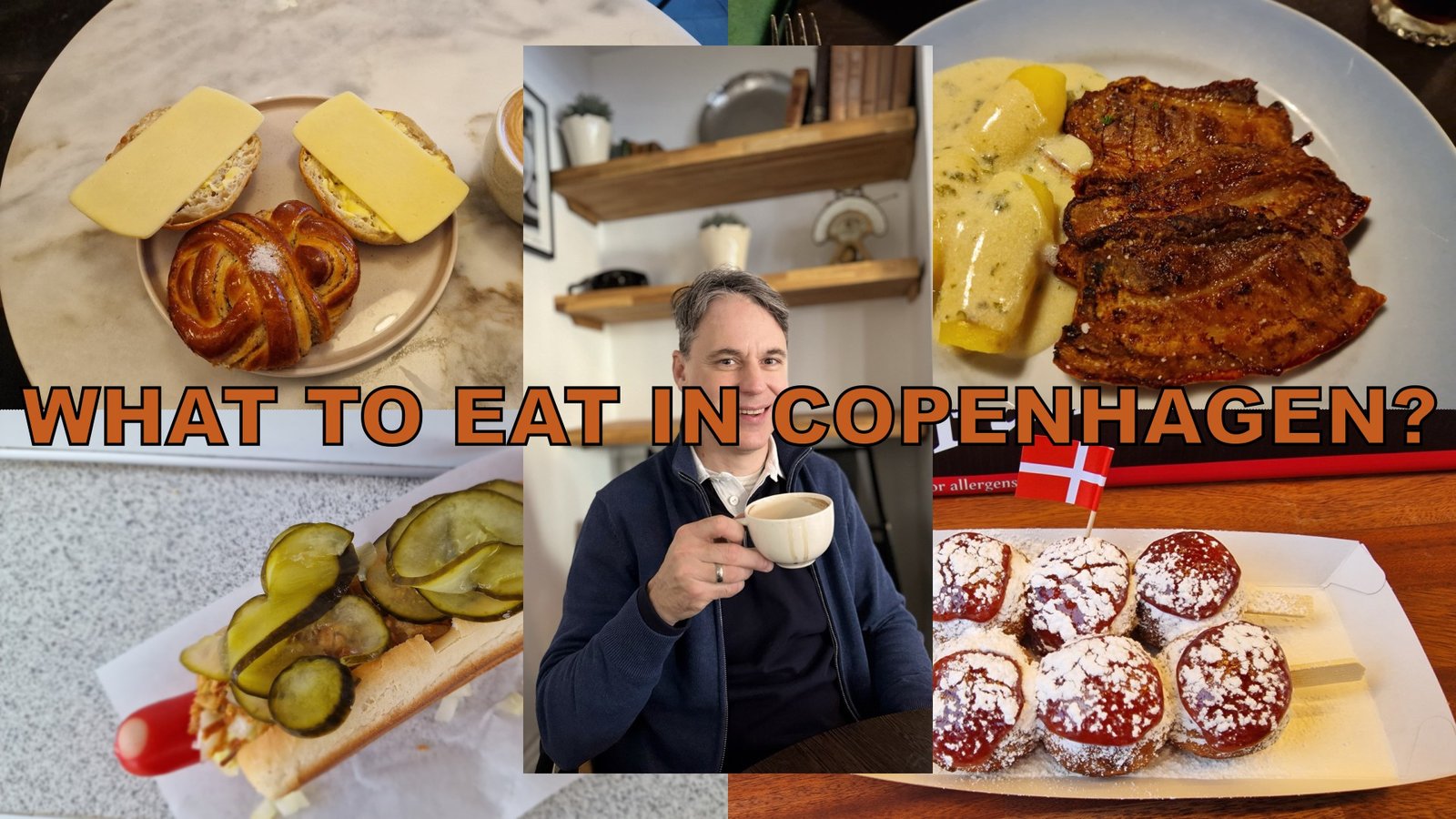
If you’re wondering what to eat in Copenhagen during a one-day visit, I’d start with a bakery breakfast, stop for smørrebrød and a hot dog, and finish with a traditional Danish dinner.
There’s also a Christmas favorite you can try outside the festive season if you visit on the right day. This Copenhagen food tour brings those stops together in places you can fit around a regular sightseeing itinerary, with food that ranges from everyday favorites to traditional Danish cooking.
I live in Copenhagen, so I visited and filmed these places on different days. I’ve put them together as a route you can follow in one day, with a few choices depending on when you visit.
What to Eat in Copenhagen in One Day
| Food stop | Where to try it | What to order |
|---|---|---|
| Bakery breakfast | Andersen Bakery, Ørestad | A bun with butter and cheese, coffee, and a Danish pastry |
| Smørrebrød lunch | Hallernes Smørrebrød, Torvehallerne | Fish fillet or potato smørrebrød |
| Danish hot dog | A traditional stand on Kongens Nytorv, or DØP by the Round Tower | A classic hot dog with Danish toppings, or DØP’s organic version |
| Æbleskiver | The pancake-ball van opposite the Round Tower | A portion with powdered sugar and jam |
| Traditional Danish dinner | Fridas, near Copenhagen Central Station | Stegt flæsk med persillesovs on its advertised day, or another Danish dish |
One detail before you plan your day: Fridas lists stegt flæsk as a Wednesday special, while the æbleskiver van was only open Friday to Sunday when I filmed. With those schedules, you have to choose. I’d go on a day when the van is open and order something else at Fridas. Check the current dinner menu and the van’s opening days before planning around those exact foods.
You can also choose just one of the two hot dog stops. I tried both, but there’s already plenty to eat on this route.
Map of the Copenhagen Food Tour
The map shows the places in this article, including both hot dog stops. Andersen in Ørestad is the main detour from the historic center; the remaining stops take you through Nørreport, Kongens Nytorv, the Round Tower area, and back toward Copenhagen Central Station for dinner. You can find hot dog stalls all around the historic center.
Kongens Nytorv, København, Denmark
Købmagergade 52A, 1150 København, Denmark
Getting Into Copenhagen and Around the Stops
Copenhagen Airport is fairly close to the city center, and the metro ride into the historic part of town takes less than 20 minutes.
For a day involving several rides, I recommend looking at a 24-hour City Pass Small in the Rejsebillet app. It gives you unlimited travel by bus, train, and metro within zones 1–4, covering the airport, Ørestad, and the central stops on this food tour.
Once you’re back from Ørestad, you can walk between the central food stops and fit in some sightseeing along the way, like Copenhagen’s hidden passageways. Having the pass still makes it easy to take a bus or metro when that suits you better.
Coffee and Danish Pastry at Andersen Bakery
If we’re going to start the day as Danes do, I’d head to a good bakery for a classic Danish breakfast: a bun with butter and cheese.

Copenhagen has several excellent bakeries, but Andersen would be my choice for this food tour. There’s a great selection throughout the day, with plenty of Danish classics alongside more modern creations, and you generally don’t have to stand in the long lines that some of the city’s most hyped bakeries attract.
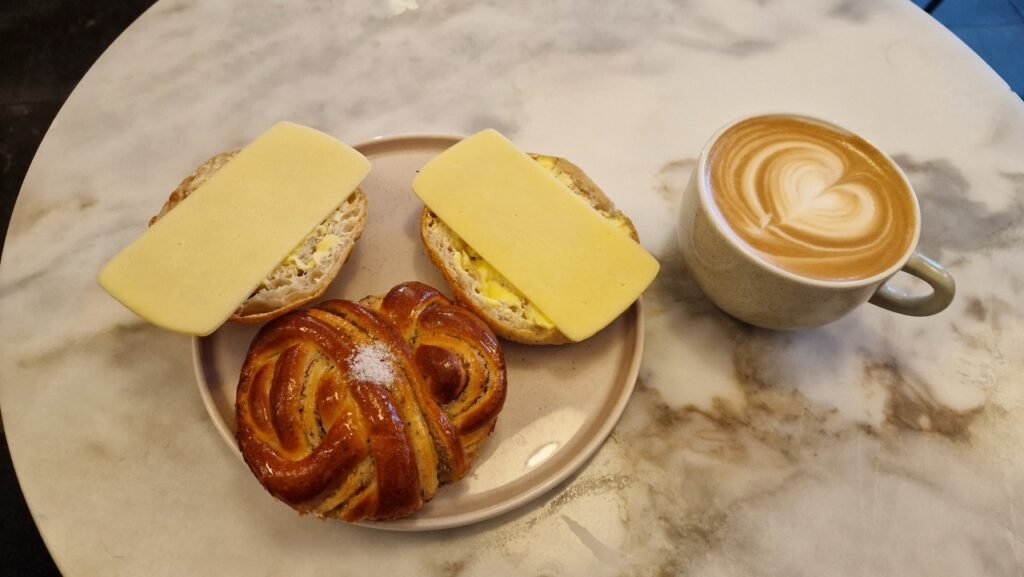
A Bun With Butter and Cheese
Known in Danish as a bolle med ost, this is about as straightforward as breakfast gets. You’ll find it in bakeries all over Copenhagen, and although it sounds simple, the quality of the bread, butter, and cheese makes all the difference.
It doesn’t need to be any more complicated than that.
Cardamom Buns, Spandauer, and Tebirkes
I also had a cardamom bun, another familiar sight in Nordic bakeries and a popular choice in Denmark. That distinctive cardamom flavor is something I associate with this part of the world, and Andersen’s was a delicious example.
I enjoyed mine with a cappuccino, watching people come and go and the elevated metro trains pass outside.
Two other Danish classics worth looking for are spandauer and tebirkes.
A spandauer is a flaky pastry with custard or jam in the middle, usually finished with a little icing. It’s probably what many people outside Denmark picture when they hear the word “Danish.”
Tebirkes has flaky layers, a sweet butter-and-sugar filling called remonce, and a generous topping of poppy seeds. It might look less elaborate than some of the pastries in the display, but it’s definitely worth trying.
Why I Recommend the Ørestad Location
For this route, I recommend Andersen’s Ørestad bakery on Ørestads Boulevard 49A. It’s farther out than their Islands Brygge location, but easy to reach: take the M1 metro to Bella Center, then walk the short distance to the bakery.
If you’re coming straight from the airport, you can take the M2 metro and change to the M1 at Christianshavn. Alternatively, take a train to Ørestad and change to the M1 there for the short ride back to Bella Center.
This trip also gives you a look at a very different Copenhagen. Ørestad is a modern, almost futuristic neighborhood, with striking architecture and an elevated metro running through it. I actually live in this part of the city, and I really enjoy it here.

Parts of the neighborhood were still under the sea less than a hundred years ago, before the land was reclaimed in the 1940s. It’s a side of Copenhagen that many tourists never get to see.
Andersen itself has an unexpected history too. Its founder, Shunsuke Takaki, visited Copenhagen in 1959 and took his enthusiasm for Danish baking back to Hiroshima, Japan. Decades later, in 2008, the company opened its first bakery in Copenhagen. The baking tradition that inspired Andersen had traveled all the way to Japan and back.
You can read more about the food, both locations, and that story in my Andersen Bakery review.
Smørrebrød at Torvehallerne
For lunch, let’s try one of Denmark’s most famous foods: smørrebrød.
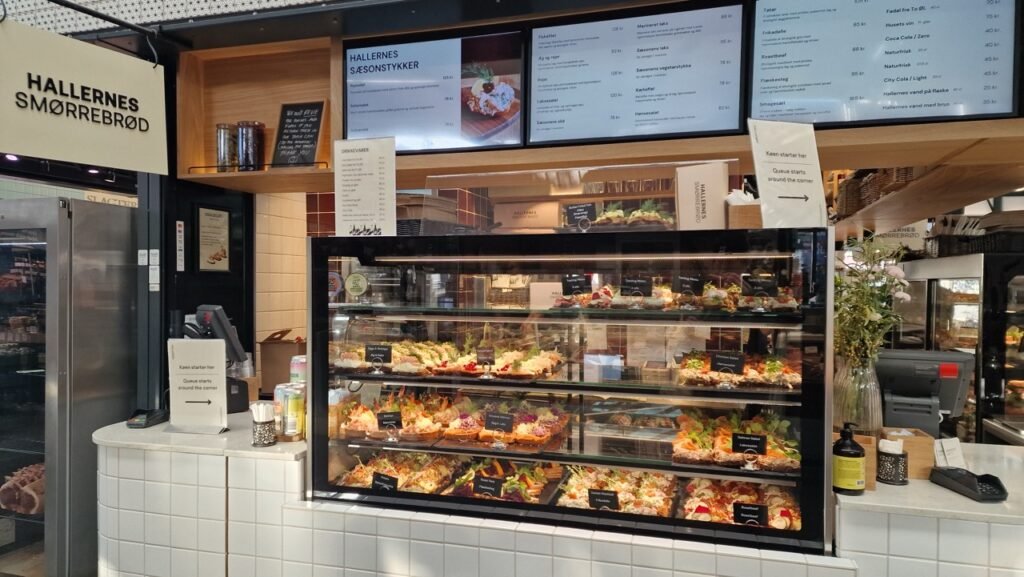
These Danish open-faced sandwiches usually start with a slice of dense rye bread, spread with butter and topped with anything from pickled herring and shrimp to roast beef, eggs, or potatoes. The name literally means “buttered bread,” although in some of the more elaborate versions, the bread almost disappears beneath the toppings.
And yes, the generously topped restaurant versions are eaten with a knife and fork.
Smørrebrød can be a simple lunch prepared at home or a carefully arranged restaurant dish. Walk into a restaurant serving traditional Danish food at lunchtime, and you’ll often find that much of the menu is devoted to it. Many of those same places serve a completely different menu in the evening, with a full selection of Danish dinner dishes.
You can try it in plenty of places around Copenhagen, but for this tour, I chose Torvehallerne food market.

Right beside Nørreport Station, its two glass halls are filled with specialty food stalls. You’re having lunch in the middle of a working market, with fresh fish, cheese, and colorful vegetables on display around you. Almost every counter seems to have something else you’d like to try. Choosing just a couple of sandwiches can actually take a little discipline.
There’s another part of the atmosphere you might not expect. Children from nearby schools use the adjoining square, Israels Plads, during their breaks. At certain times of day, you’ll hear them running around, shouting, playing, and enjoying themselves. An open public square right in the heart of the capital becomes their school playground.
What I Tried at Hallernes Smørrebrød
Hallernes Smørrebrød is probably one of the best-known counters among visitors. There’s often a line, but for the atmosphere and central location, I think it’s worth waiting.
The sandwiches are laid out in the display, so you can see exactly what you’re ordering. And if you have no idea how to pronounce the Danish names, just point to whichever one looks good.
I chose two traditional options: a breaded fish fillet with Danish remoulade, and a potato sandwich.
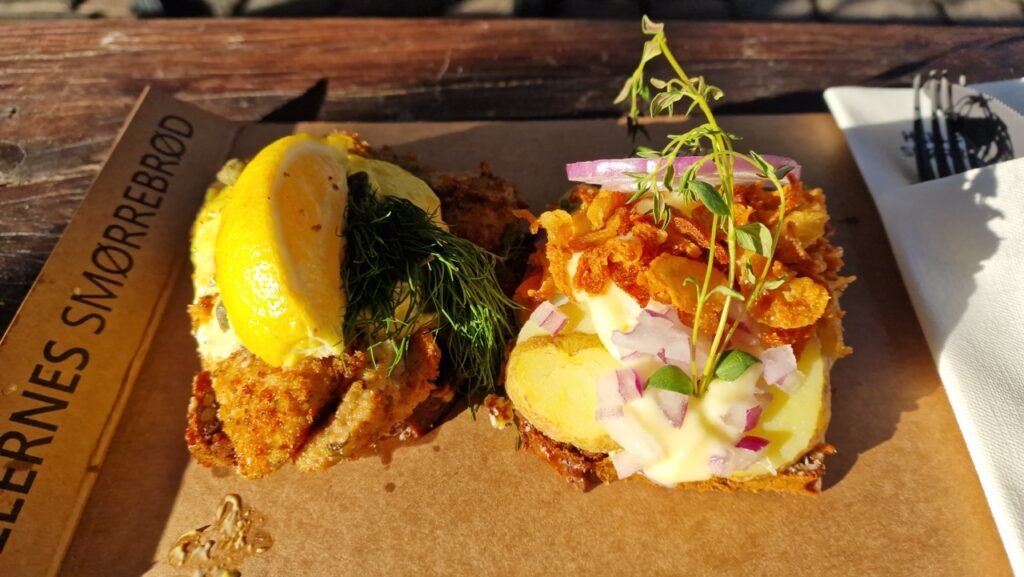
The potato one was a simple combination of cold boiled potatoes, bread, butter, and fried onions. It’s easy to overlook something like this when you have all those fish and meat options in front of you, but potatoes have their own very traditional place on Danish smørrebrød. Simple as it was, I liked it.
The fish version came with remoulade, capers, lemon, and a very generous amount of dill. I squeezed some lemon over it before trying it, and this one was good too.
Both were a straightforward introduction to Danish lunch food, with the market and the square adding something extra to the meal.
Click the linke to read my traditional Danish smørrebrød recipe.
A Danish Hot Dog From a Stand
A hot dog might not sound like the highlight of a culinary tour, but no Danish street food experience would be complete without trying one from a stand.
These stands are so common that you’ll come across plenty of them just by strolling around Copenhagen. I tried two versions: a regular hot dog on Kongens Nytorv and the organic version from DØP by the Round Tower.
A Classic Red Hot Dog on Kongens Nytorv
You’ll probably pass through Kongens Nytorv during your visit, even if it’s just on your way to the colorful houses of Nyhavn. That made it an easy place to stop for a regular Danish hot dog.

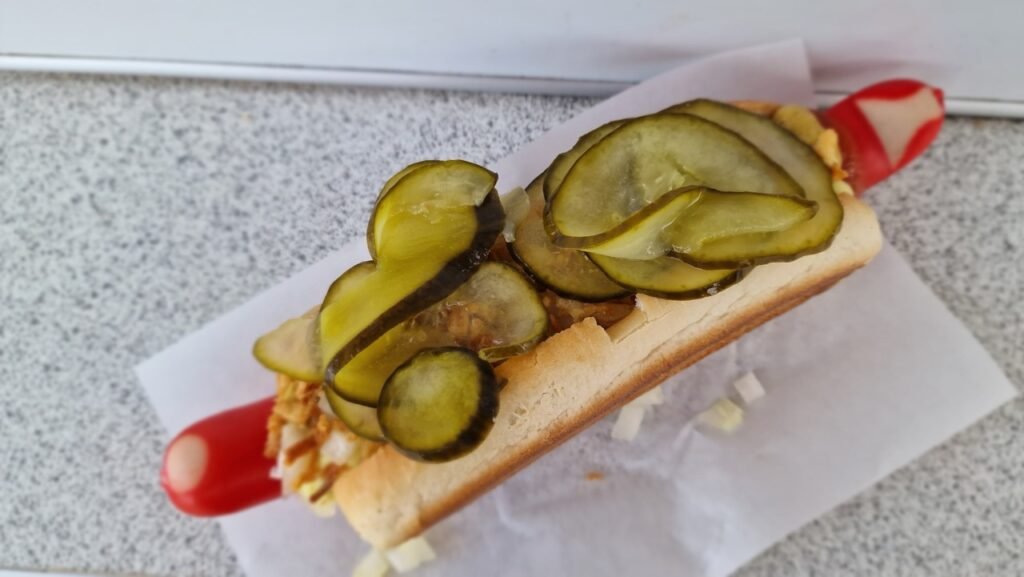
You can choose from several types of sausages. Two classic options are the boiled red sausage and the ristet pølse, a sausage browned on a hot plate. I went for the boiled one, with that distinctive bright red color that’s so familiar here in Denmark.
The sausage and bread are straightforward enough. The toppings give the hot dog its Danish character: crispy fried onions, finely chopped raw onions—sometimes red—and slices of pickled cucumber.
Then come the sauces: mustard, a mildly spiced Danish hot dog ketchup, and remoulade. Danish remoulade is a creamy sauce with finely chopped pickled vegetables and a slightly sweet, tangy flavor. Turmeric is often added to give it that familiar yellow color and distinctive taste.
You get the soft bread and sausage, the crunch of the onions, and the sweet, sharp, and creamy toppings together. Eating it right there at the stand is part of the Danish street food experience.
The Organic Hot Dog at DØP
For something a little more elaborate, I also tried DØP. They have two locations downtown, and I visited the one beside Rundetaarn, Copenhagen’s Round Tower.
The sausages, bread, and toppings are organic. The bun is whole grain and topped with flaxseeds, and the choices include specialty sausages such as spicy beef and goat, as well as a vegetarian option.
The DØP hot dog was a little more flavorful than the regular one I tried at Kongens Nytorv, although I definitely enjoyed both.
A regular stand is an easy choice wherever you happen to be sightseeing. DØP is worth seeking out if the organic ingredients and more elaborate version appeal to you.

And from their stand by the Round Tower, the next stop is just across the street.
Æbleskiver Outside the Christmas Season
A sweet treat doesn’t get much more Danish than æbleskiver. But they’re mainly a Christmas tradition, so finding them outside the festive season takes a little more effort.
In the weeks leading up to Christmas, Danes enjoy these little pancake balls, often accompanied by a glass of gløgg—the local version of warm, spiced wine. They’re something to sit down and enjoy during the Christmas season, rather than simply a dessert you order after dinner.
Æbleskiver are made from a pancake-like batter, cooked in a special pan with deep, rounded hollows. As the batter sets, each one is turned a little at a time with a skewer, gradually forming a ball. Freshly made, they’re soft and airy inside, with a lightly crisp surface.
They’re served warm with powdered sugar and strawberry or raspberry jam.
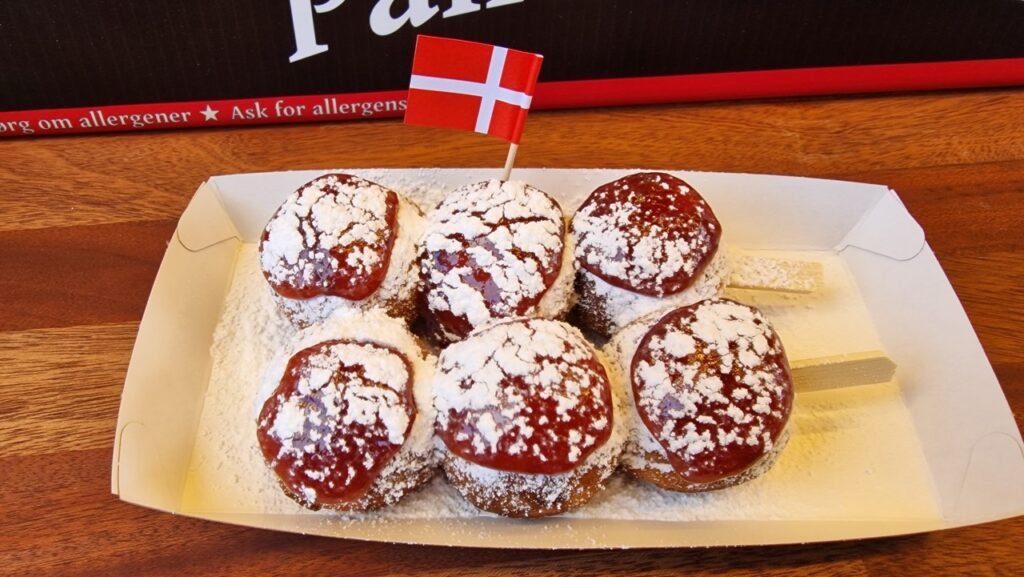
There’s also a little trap in the name: æbleskiver literally means “apple slices.” Most modern versions contain no apple at all, and they’re not slices either.
The Æbleskiver Van by the Round Tower
The little pancake-ball van opposite the Round Tower sells æbleskiver throughout the year, although not every day. When I filmed my visit, it was only open on Fridays, Saturdays, and Sundays. Check the current opening days before making a special trip.
And to tell you the truth, these weren’t the best æbleskiver I’ve tasted. They’re made in a bakery and reheated at the van, so you’re not getting them straight from the pan.
Still, if it’s open when you’re passing, I’d recommend trying a portion, especially if you’ve never had them before. It gives you a chance to try a very Danish Christmas tradition even if you happen to be visiting in the middle of summer.
If you want to try making them yourself, here’s my traditional æbleskiver recipe, including how to turn them in the pan.
A Traditional Danish Dinner at Fridas
For dinner, my recommendation is Fridas, a traditional Danish restaurant just three blocks from Copenhagen Central Station.
With a location this convenient for visitors, I was a little suspicious that it might be a tourist trap.
Walking inside feels like going back to the 1970s or 1980s. There’s dark wood paneling, floral upholstery, old-fashioned lamps, and royal memorabilia on the walls. Almost everyone around us was speaking Danish, and the restaurant turned out to be quite the opposite of what I’d feared.
Both waiters who served us were very friendly and spoke excellent English, and the menu had English descriptions too. Danes were clearly happy to eat here, and we were made just as welcome.
Stegt Flæsk med Persillesovs
We came for stegt flæsk med persillesovs: crispy pork belly with boiled potatoes and parsley sauce. This simple combination was voted Denmark’s national dish in 2014.
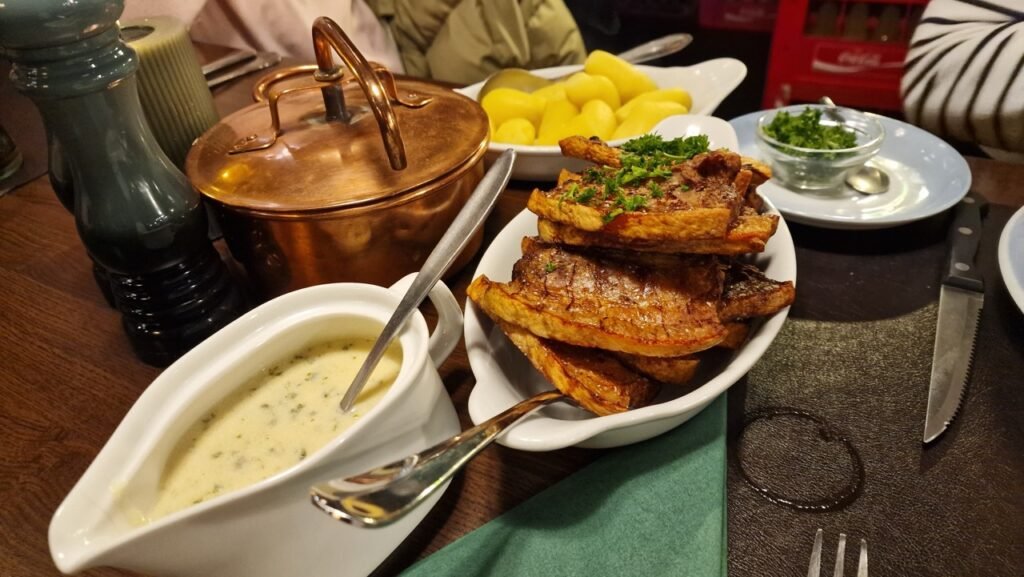
The pork belly is cut into fairly thick slices, with the skin left on, then fried or roasted until browned and crisp. Much of the fat renders out during cooking. Add whole boiled potatoes and traditional Danish parsley sauce, and that’s the dish.
I’d made it myself shortly before this visit, so I was curious to see how a traditional Danish restaurant would prepare it. If you want to try it at home, you can follow my stegt flæsk med persillesovs recipe.
The first thing that struck us was the portion size. We ordered for two, but the platter looked as though it could easily have fed three people, possibly four less determined ones.
The pork was properly browned and crisp, including the skin. Our server noticed we’d left some of the crispiest pieces behind and told us we were leaving the best part.
Danes also eat pork crackling as a snack, and Fridas even had packets of it for sale. So those crispy pieces aren’t supposed to stay on the plate.
The potatoes were good, and the parsley sauce brought everything together. I would have preferred a little more parsley—they used noticeably less than I do at home—but I really enjoyed the meal.
Old-Fashioned Apple Cake for Dessert
Despite the amount of pork we’d just eaten, I still ordered dessert. Strictly for research purposes, obviously.
I tried gammeldags æblekage, or old-fashioned apple cake. Despite the name, it arrived in a glass: apple compote, almond-flavored crumbs, and a very generous amount of whipped cream.
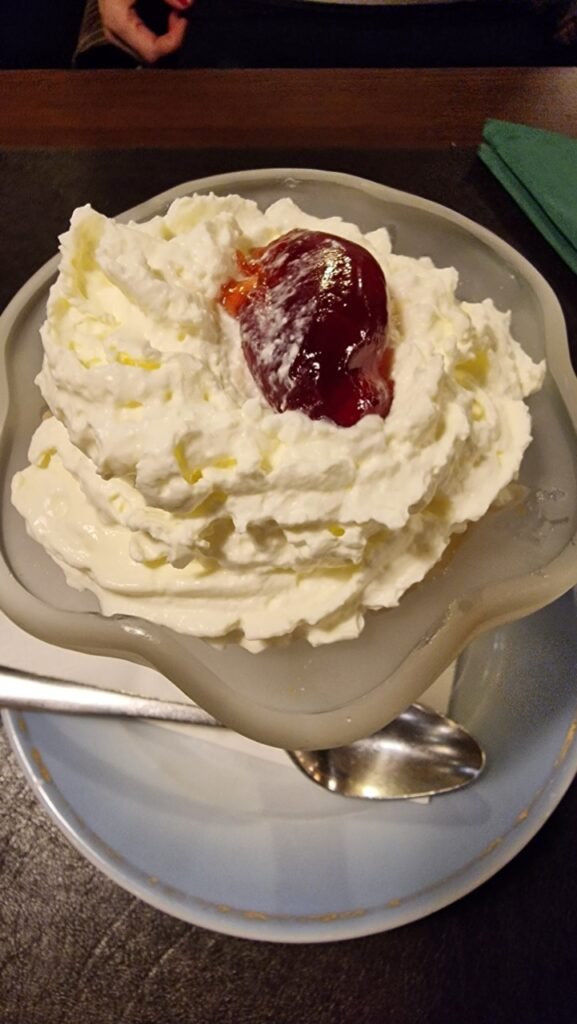
I enjoyed it, although it was a little too sweet in places. By then, I was already completely full from that huge portion of pork.
Stegt flæsk is just one of the traditional Danish dishes on the menu, so there’s plenty to choose from if you visit on another evening. You can read the full account of the meal in my Fridas restaurant review.
My One-Day Taste of Copenhagen
That’s how I’d put together a day of traditional Danish food in Copenhagen: a bun with butter and cheese, smørrebrød, a hot dog from a stand, æbleskiver, and a proper dinner at Fridas.
Of everything on this list, æbleskiver are probably the most distinctly Danish. If you’re visiting outside the Christmas season, that little van is a useful find, even if you can have better æbleskiver elsewhere.
Pick the stops that appeal to you, work around the opening days, and leave enough room for dinner. That enormous platter at Fridas is worth remembering when you’re deciding how many pastries to order in the morning.
For another city’s local food, have a look at my one-day food tour in Oslo.