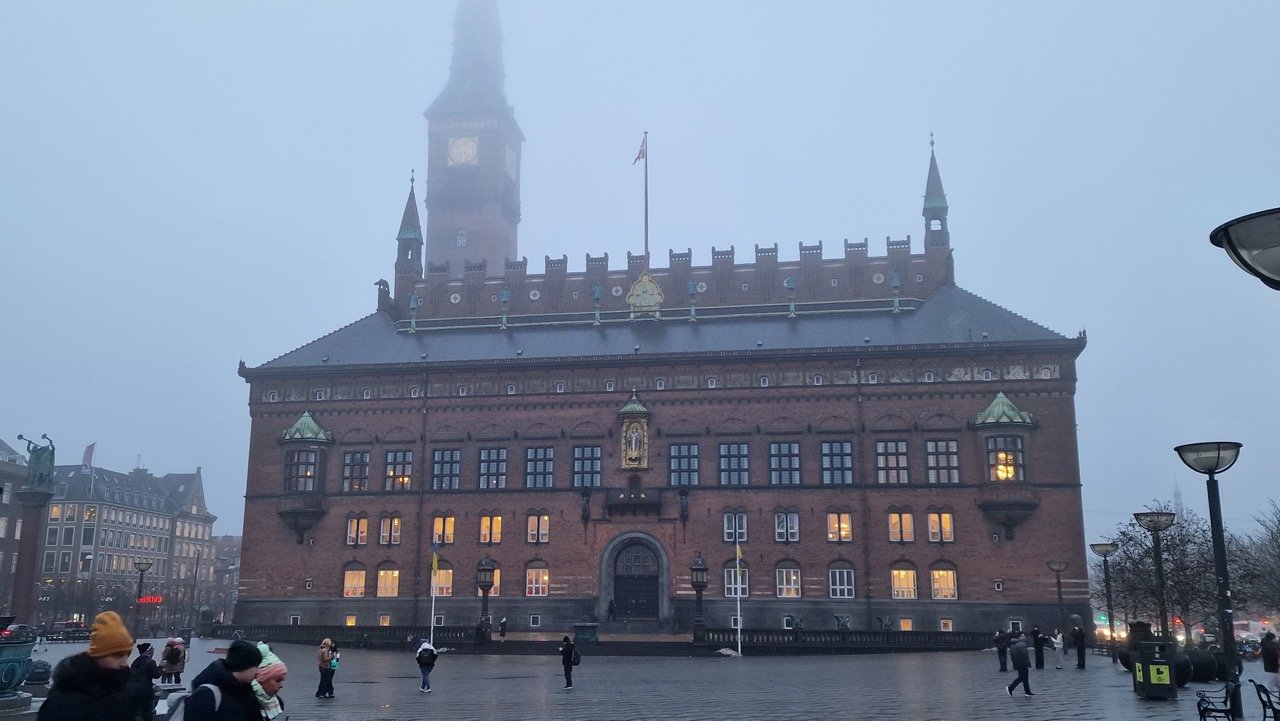
Did you know you can enter Copenhagen City Hall for absolutely free?
It’s a magnificent building right on Rådhuspladsen, in the very heart of Copenhagen. Thousands of tourists pass by it on their way to Tivoli, Strøget, or Copenhagen Central Station. Yet many never even think to step inside.
And that’s a shame, because Copenhagen City Hall is much more than just an impressive building to admire from the outside.
The reason you can visit is simple. Copenhagen City Hall is a functioning public building, and here in Denmark, public really can mean, well… public. Mostly, of course.
During opening hours, you can simply walk in and explore the public areas, admire the architecture, and discover some surprisingly interesting details. Lots of weddings are held here, too, so don’t be surprised if you come across a newlywed couple along the way. There’s even a little hidden gem that, according to an employee we spoke to, most visitors miss.
So let me show you what you can see inside Copenhagen City Hall and why I think it’s worth adding to your itinerary. And to make planning easier, you’ll also find an interactive map at the end of this article.
Can You Really Just Walk Around Copenhagen City Hall?
Yes, you really can. During opening hours, you can simply walk through the main entrance and explore the public areas of Copenhagen City Hall. No ticket, no reservation, and no guided tour required.
And what makes this experience particularly interesting is that you’re not visiting a museum. You can wander through the corridors, admire the architectural details, and even walk past offices where city employees are going about their everyday work.
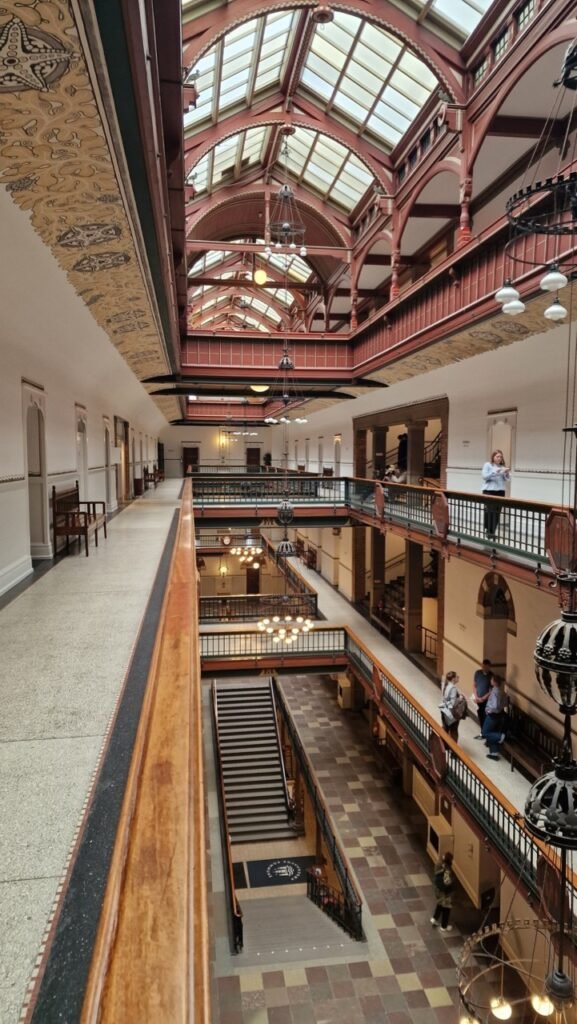
Of course, that doesn’t mean you can go absolutely everywhere. Some areas are restricted, and you should naturally respect the privacy of the people working there.
But that’s also part of what makes the visit so special.
This is not a preserved historic building emptied for tourists. It is still doing its original job. People work here, couples get married, and the city administration continues to function around you.
And somehow, you get to experience all of this while exploring one of Copenhagen’s most impressive historic buildings, completely free of charge.
Stepping Into the Main Hall
For me, the most impressive part of Copenhagen City Hall is undoubtedly the enormous main hall, or Rådhushallen, just beyond the entrance.

And honestly, even if this were the only part of the building you could visit, I would still recommend coming here.
It’s a magnificent space, with a beautifully patterned tiled floor, tall columns, arches running along the upper galleries, and an enormous glass roof that lets natural light into the building. Large Danish flags hanging from all four walls make the hall even more impressive, with a Greenlandic flag and a Faroese flag at the far end.
What’s particularly interesting is that the hall was designed almost like an outdoor city square, surrounded by buildings. Except that, considering the Danish weather, it was probably a good idea to put a roof over it.
Just standing in the middle of this space and looking around is an experience in itself.
The City Hall Library – Another Hidden Gem
Another part of Copenhagen City Hall you really shouldn’t miss is the beautiful old library, or Rådhusbiblioteket.
The library dates back to 1905, when City Hall first opened, and was also designed by Martin Nyrop. Although it stopped functioning as a traditional library in 2015, the magnificent historic interior has been preserved, and the space is still used as a reading room.
It’s a lovely room with beautiful old furniture and architectural details, and definitely worth exploring. Just keep in mind that people may actually be studying here, so try not to disturb them.
But there’s another reason I particularly recommend coming up here.
The library windows offer a wonderful view of Rådhuspladsen, Copenhagen’s City Hall Square, from above. And what’s even better, one of the windows can actually be opened, giving you an unobstructed view of the square below.
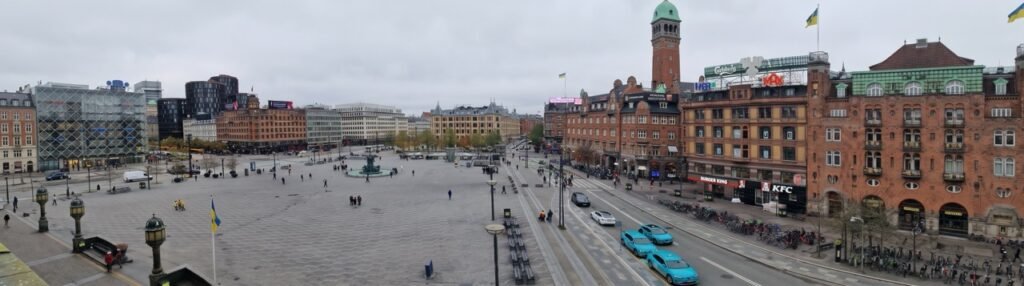
It’s a completely different perspective on one of Copenhagen’s busiest places, and another little detail that makes visiting City Hall so special.
A Little History of Copenhagen City Hall
The building was designed by Danish architect Martin Nyrop and constructed between 1892 and 1905. It was officially inaugurated in September 1905, after thirteen years of construction.
Its architecture belongs to the National Romantic style, with inspiration from historic Italian town halls, particularly the one in Siena.
But don’t expect a simple imitation of an Italian building. Copenhagen City Hall has a distinctly Danish character, combining traditional craftsmanship, decorative details, and an impressive sense of scale.
And Nyrop paid attention to almost everything. From the grand architectural elements down to lamps, furniture, and even door handles, the building was designed as a unified work.
That attention to detail is something you can appreciate even without knowing anything about architecture.
Take Your Time and Look Around
My recommendation is not to rush through the main hall just to take a photo and leave.
Walk around the space, look up at the galleries and glass ceiling, and pay attention to the decorative details on the walls, columns, and surrounding corridors.
There are little things everywhere that you might not notice at first glance. Some of the decorations even tell stories about Copenhagen and its history.
My personal favorites are the two little lion-head fountains tucked into the inner corners of the hall. They’re easy to miss in such a magnificent space, but that’s exactly the kind of detail I love discovering in a building like this.
And remember, this isn’t just an impressive historic interior. The hall is still used for public events, exhibitions, official receptions, and other activities.
If you simply walk around this space and take in all the details, you’ve already made your Copenhagen visit a little more special.
And the best part is that you haven’t spent a single krone to experience it.
Don’t Miss the Courtyard Garden
There’s one more part of Copenhagen City Hall that I would definitely recommend exploring: the courtyard garden, or Rådhushaven.
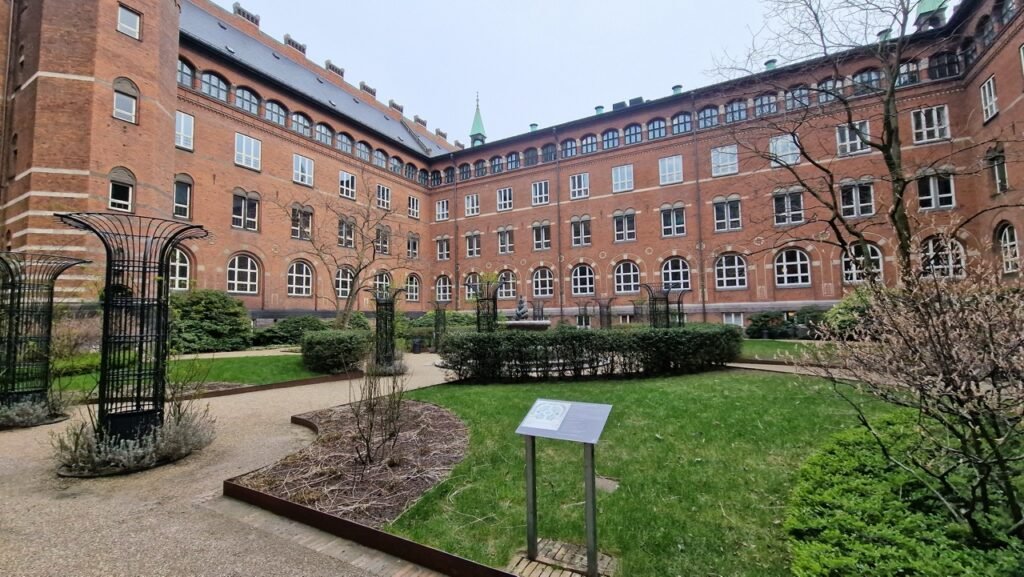
This is probably one of the most overlooked parts of the entire building.
In fact, an employee we spoke to told us that even many visitors who already know they can enter Copenhagen City Hall completely miss the courtyard garden.
And I can understand why. It’s tucked away behind the main parts of the building, and unless you know it’s there, you might never think to look for it.
But once you find it, you’re rewarded with a lovely little garden surrounded by the impressive red-brick walls of City Hall. There are trees, greenery, benches, and a fountain, all hidden away from the busy streets of central Copenhagen.
It’s a surprisingly peaceful place, especially considering that Rådhuspladsen, one of the city’s busiest squares, is just outside.
So if you want to make your Copenhagen visit a little different from what most tourists experience, don’t stop at the main hall. Make sure you find the courtyard garden, too.
How to find it: From the main hall, take one of the side corridors, either on the left or the right, and walk toward the back of the building. Head down the stairs, go through the door, and you’ll find yourself in the courtyard garden.
Jens Olsen’s World Clock – Much More Than Just a Clock
And before leaving Copenhagen City Hall, there’s one last thing you really shouldn’t miss.
Just to the right of the main entrance, you’ll find Jens Olsen’s World Clock, or Jens Olsens Verdensur in Danish.
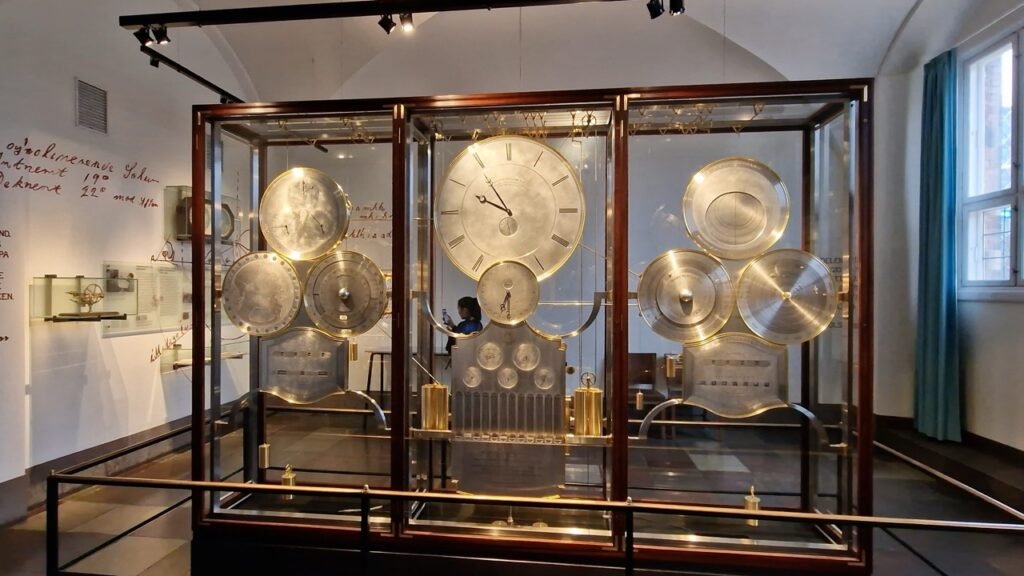
At first glance, it looks more like a collection of complicated mechanical instruments than an ordinary clock. And that’s because it does much more than simply tell the time.
This extraordinary mechanical clock contains 14,448 individual parts and was first started in 1955. It shows not only the local time, but also the time in different parts of the world, the positions of celestial bodies, and even the night sky above Copenhagen City Hall.
It can also calculate the dates of future holidays and full moons. In fact, every New Year’s Eve, the mechanism spends six minutes calculating this information for the coming year.
Is Copenhagen City Hall Worth Visiting?
Absolutely. In fact, I think it’s one of the easiest ways to add something special to your Copenhagen visit without spending a single krone, a real hidden gem.
You don’t need to spend hours here. Even twenty or thirty minutes exploring the main hall, admiring the architectural details, and discovering the courtyard garden can be a memorable experience.
And what I particularly like is that this isn’t a conventional tourist attraction. It’s a real, functioning public building that happens to be magnificent, and where visitors are welcome to explore.
So if you’re spending even just one day in Copenhagen, I would definitely recommend adding City Hall to your itinerary. It’s right in the middle of the city, costs nothing to enter, and gives you the chance to discover something that many other tourists simply walk past.
Where Is Copenhagen City Hall?
Copenhagen City Hall is located right on Rådhuspladsen, literally City Hall Square, in the very center of Copenhagen.
It’s right next to Tivoli Gardens, at the western end of Strøget, and just a short walk from Copenhagen Central Station.
If you’re using public transportation, Rådhuspladsen metro station, served by lines M3 and M4, is probably the easiest option. You’ll emerge practically in front of the building.
I’ve marked Copenhagen City Hall on the interactive map below to help you find it and plan your visit.