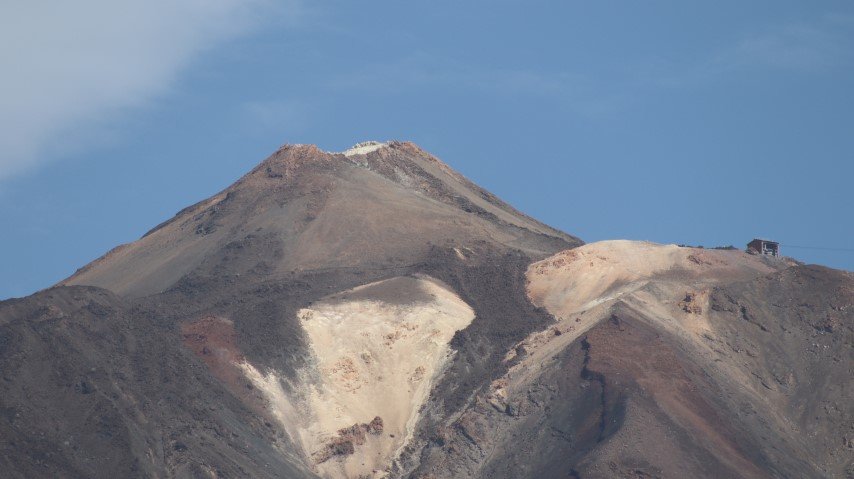
Volcano Teide—or simply Teide—is one of the jewels of Tenerife, one of the Canary Islands’ most beloved islands, and very deservedly its most popular attraction.
At 3,718 meters (12,198 ft), Teide is a defining sight not only from almost every point of the island, but even from the plane. And visiting the volcano is one of those experiences that’s almost unmissable, whether you’re vacationing here or living here.
Teide: Comfortably Above 3,000 Meters
Volcano Teide is very easy to reach. For one, you can get here from almost anywhere on the island in about 1–1.5 hours, whether by car or even by scheduled bus. For another, you can get up comfortably and simply all the way to 3,555 meters (11,663 ft) with the Teleférico—basically a cable car (or gondola). And thanks to where the Canary Islands are located, you don’t have to expect extreme cold weather even in winter.
So I have to say: Teide might be the place where you can try what it feels like above 3,000 meters (9,843 ft) the closest to Hungary—and the most comfortably—any time of the year.

But let’s look in more detail at what’s worth knowing about Teide as a tourist!
How to Get to Teide
Getting to the “foot” of Teide—meaning the cable car’s lower station (which itself is at 2,356 meters / 7,730 ft)—is very easy, either by rental car or by scheduled bus.
Honestly, as a Hungarian, even this part is an experience in itself. On the one hand, you travel through landscapes that feel like you’re actually on Mars. On the other hand, you get here on a beautifully maintained mountain road—and once you realize you’re already above 2,000 meters (6,562 ft), that’s pretty mind-blowing too for a tourist coming from the land of the Great Hungarian Plain.

If you’re coming by car, roads lead here from every side of the island. Just type “Teleférico del Teide” (Teide cable car) into your navigation, and it’ll take you there. From the north, TF-24 or TF-21; from the south, TF-21; and from the west, TF-38.

The parking lot by the lower cable car station fills up pretty quickly, so be prepared to walk several hundred meters—or even more—if you arrive after 11 AM or noon.
On an island that already has very good bus transportation, two scheduled lines also take you up to the volcano. From the northern coast, the 348 (timetable via the link) runs from Puerto de la Cruz; from the southern coast, the 342 (click for the timetable) comes up from Costa Adeje / Los Cristianos. What’s important to know, though, is that these buses only run once per day: they go up in the morning and come back in the early afternoon.
How to Get Up on Teide
As I wrote above, even the lower station at 2,356 meters (7,730 ft) is an experience. But if you’re here, it’s a shame to skip the summit—or at least the cable car’s upper station. There aren’t many places where you can get above 3,000 meters (9,843 ft) this easily and comfortably.
You have three options for “conquering” Teide. For these, you need to plan ahead—and in some cases, book in advance.
1. Teide Cable Car / Gondola
The Teleférico del Teide—the Teide cable car—does not take you all the way to the summit. The upper station is “only” at 3,555 meters (11,663 ft), but you can get up there very easily. In 2024, a round-trip ticket costs €40 for adults and €20 for children.

One thing to watch out for: this is a very popular destination, so forget the idea that you’ll just show up and buy a ticket on the spot. There’s some chance, but it’s definitely better to book online via this link in advance.
The reservation is for an exact time slot. Since parking can be quite tricky in the area, I strongly recommend arriving well before the departure time on your ticket.
It’s important to note that since we’re talking about a high mountain and nature, storms can happen. In that case, the cable car can be stopped at any time—even for several days. If that happens, you’ll be notified via the email address or phone number you provided, and your ticket can be moved to another time when there’s availability. Still, it’s something you should definitely factor in—because if you’re only traveling to the Canary Islands for a few days, then unfortunately, even with the most careful planning, the Teide trip can still end up not happening.
2. The Summit of Teide
Getting to the summit of Teide is a tougher nut to crack. In theory, anyone can go up—but in practice, to protect the area, from the cable car’s upper station onward, you can only go to the summit with prior registration, and in limited numbers.
This is free of charge, and with the reservation you only obtain the authorization itself. So from the upper station to the summit, you still have to hike on foot—and be ready for a fairly steep climb above 3,500 meters, where there’s noticeably less oxygen.

Spots are very limited, and interest is huge. Because of that, they usually issue all permits 1–2 months in advance. So if you want to reach the summit of Volcano Teide, it’s worth booking very early—at least 3 months before your trip.
The permit can be requested online via this link.
3. Hiking Up Teide
You can also hike up to the cable car’s upper station on a proper trail (up to this point, you don’t need a separate permit). You can even combine this with the cable car: buy a one-way ticket (available at half price), and do the other direction—either down or up—on foot.
In this case, though, be prepared for a hard hike, and I truly only recommend it if you have experience with mountain hiking. The terrain itself is not particularly difficult—though I haven’t personally done it—but on the roughly 8 km (about 5 miles) route, the elevation gain between the parking area and the upper station is about 1,200 meters (3,937 ft), which can be exhausting in itself for an inexperienced hiker. Also, above 3,000 meters (9,843 ft) there’s noticeably less oxygen, which makes the climb harder and can create unexpected situations if you’re not used to it. And third: the weather can be very different between the parking lot and the upper station.
What Should You Wear on Teide?
If you’re going to Teide, it’s worth thinking through what you’ll wear. At parking level (the cable car’s lower station), the weather is usually similar to what you’re used to elsewhere on the island—which in most cases means something like 20–30°C (68–86°F).
But if you go up by cable car, the upper station can feel like you’ve arrived in another world. And not just because of the thinner air, but also because of the cold and the wind. Add to this a pretty sneaky kind of sunshine: because it’s cold and you’re high up, you don’t really feel it, but you can get sunburned very quickly if you don’t wear a hat or longer clothing.
So for the lower station, the Tenerife-style shorts-and-t-shirt outfit (or very light clothing) makes sense. But if you’re going up, bring at least a sweater—better yet, a jacket—and definitely a hat. Sunglasses are also strongly recommended!
More Information About Teide
On the links below, you can find more information about Teide:
- Teide Wikipedia page
- volcanoteide.com — information and ticket booking (English, Spanish, plus a few other languages)