Although Denmark is an EU member, it’s one of the countries that did not adopt the euro. So there’s a separate, national currency in Denmark. The Denmark currency is the Danish krone, DKK, Danske kroner.
The Danish krone has been part of the so-called ERM II mechanism since 1999 (more on that below), which is why its exchange rate is tightly pegged to the euro. The krone and the euro move almost in lockstep. €1 is between 7.46 and 7.47 Danish kroner.
Denominations of the Danish Krone
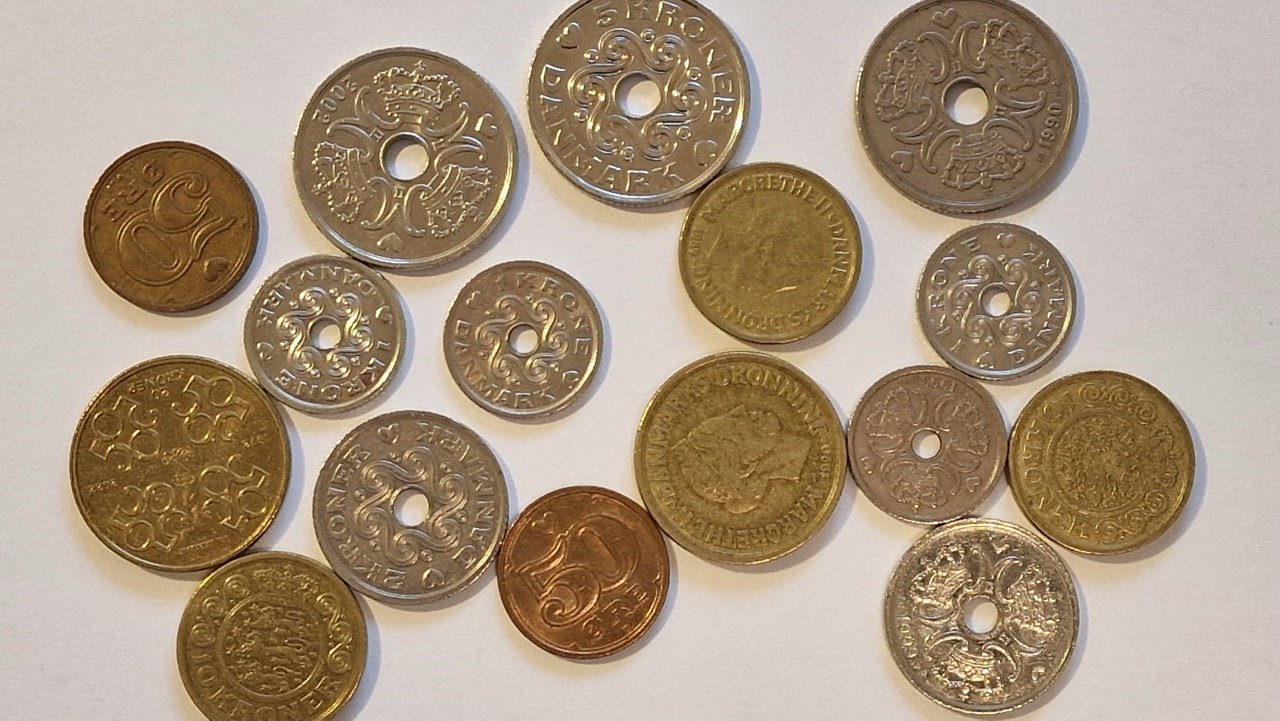
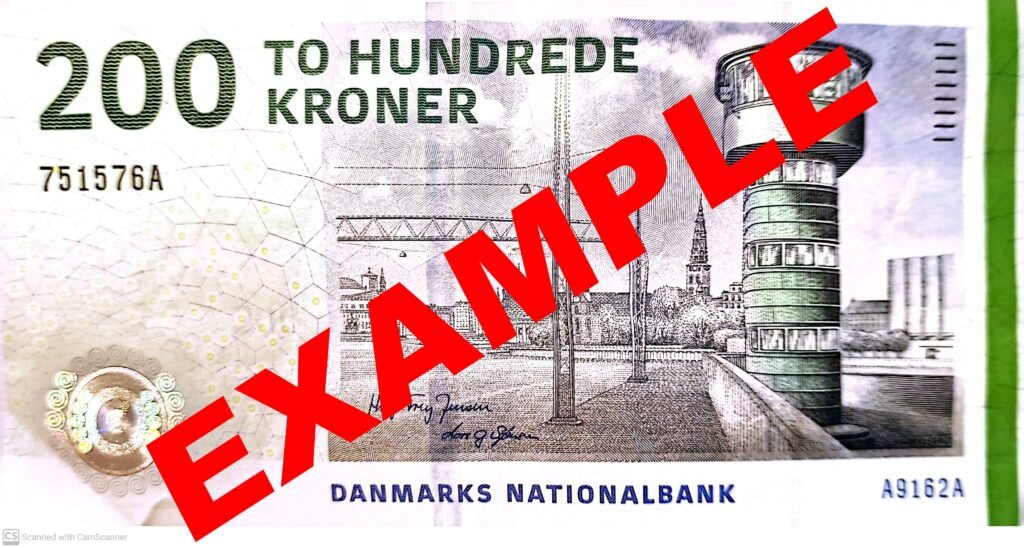
The Danish krone currently circulates in the following cash denominations:
Banknotes
- 50 DKK
- 100 DKK
- 200 DKK
- 500 DKK
Note: there used to be a 1,000-krone banknote, but it has not been usable since May 31, 2025.
Coins
- 50 øre (½ DKK)
- 1 DKK
- 2 DKK
- 5 DKK
- 10 DKK
- 20 DKK
Card and Mobile Payments
If you’re in Denmark—whether visiting or living here—you’ll almost never need cash. Card and mobile payments aren’t just widely accepted; in practice, everyone uses them. It’s rare to see someone pay with cash.
And although Danish kroner are accepted everywhere as legal tender, that ubiquity of cashless payments makes it almost unnecessary to exchange money before you travel or withdraw kroner locally. Of course, you can withdraw cash at local ATMs. But as a tourist—and since I’ve lived here—I’ve hardly ever needed it; you can pay for everything, everywhere, by card.
Danes also use a service called MobilePay for payments and peer-to-peer transfers. To open a MobilePay account you need an official Danish address and residence permit.
How Do You Pay?
There’s a small quirk to be ready for—and it nicely shows how widespread card payments are.
Wherever you shop or order, as soon as the clerk rings up your items, the total automatically appears on the payment terminal sitting in front of you. Often they won’t say anything—just wait for you to handle the payment yourself.
That’s expected at a supermarket checkout. But it’s the same in a café: you order at the counter, they enter the items, the amount pops up on the terminal. Because people here are patient and polite, no one will prod you—they’ll simply carry on. Until you tap your card, they won’t start your order. This has surprised first-time visitors who kept waiting for their coffee while no one had started making it yet—because the bill wasn’t paid.
The Danish Krone and the Euro
Denmark is the only EU country that requested and received an opt-out from adopting the euro—even in the long term.
In practice, that means the Danish krone (DKK) is not only the current official currency in Denmark—and therefore in Copenhagen—but it’s also not expected to be replaced by the euro.
Back in 1999, Denmark joined the ERM II exchange-rate mechanism. Practically speaking, the krone’s rate cannot deviate by more than ±2.25% from the euro’s central rate. In other words, EUR and DKK move almost entirely together.
At the time of writing, in the past five years the DKK has moved very little: €1 traded between 7.44 and 7.47 DKK, recently (2024–2025) a touch weaker for the DKK, near 7.47. For quick mental math, you can treat €1 ≈ 7½ DKK and 1 DKK ≈ €0.13.
In Copenhagen you’ll also find many ATMs that dispense not only DKK but sometimes EUR or even SEK (Swedish kronor). These are usually separate machines, so if you do need cash, check which currency each ATM issues.
A final curiosity on exchange rates: the DKK’s value has long been very close to Croatia’s former kuna (HRK); Croatia adopted the euro at 7.5345 HRK per €1, which sits near the DKK–EUR peg.