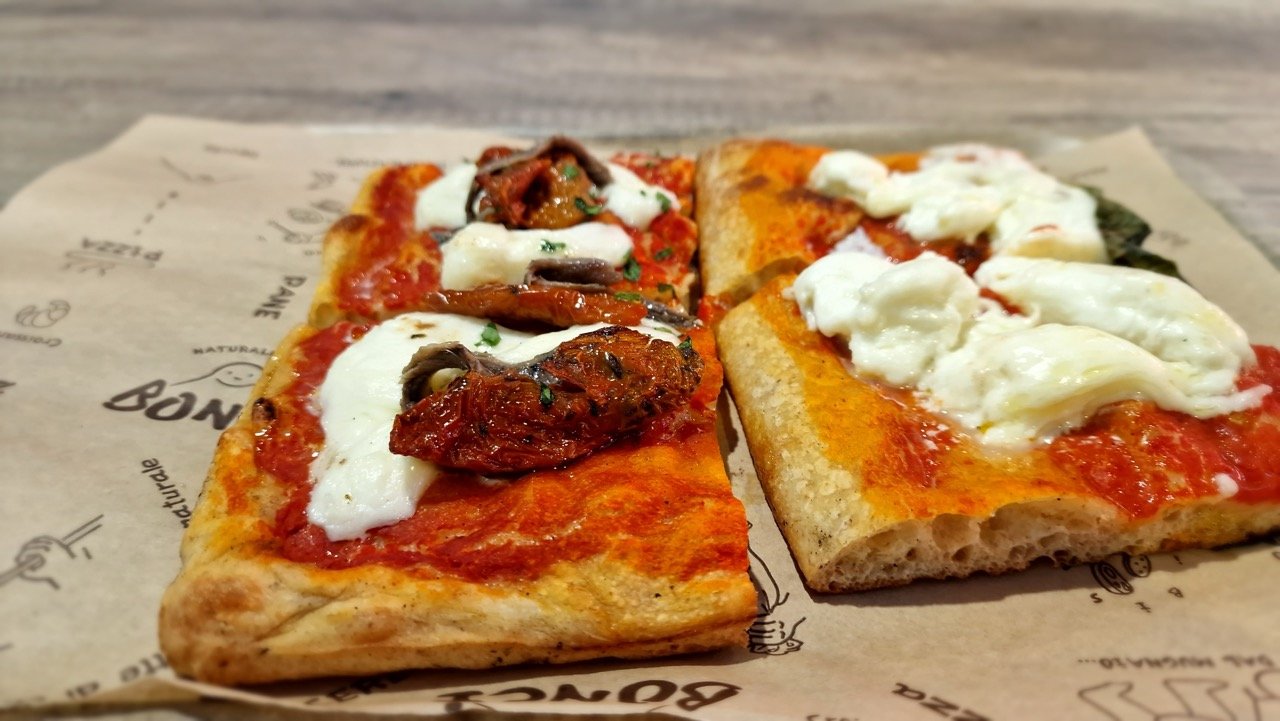
Maybe you’ve heard of it, maybe you’ve even come across it. Pizza al taglio is just as common in Rome and its surrounding areas as it is unfamiliar in most other parts of the world.
But what exactly is pizza al taglio?
Before I give you the answer, let’s start with a little social commentary!
How many kinds of pizza are there?
Unfortunately, our ideas about food have become overly Americanized. Or at the very least, we tend to look at food through a narrow, local lens.
When you think of pizza, for most people it means their local version—which often only vaguely resembles traditional Italian pizza. Think New York or Chicago styles in the U.S., mayo-covered white pizza in Transylvania, or Hungarian-style pizza with eggs and milk in the dough. These are all unique in their own way, but not exactly “Italian.”
And when it comes to “authentic” Italian pizza, many American YouTubers and influencers point to Neapolitan pizza as the only true one. That’s fine—as long as they clarify that they’re talking specifically about Naples-style pizza. And if we’re being purist, there are really only two official versions.
Italy and Its Regional Cuisines
And this brings us to something many food experts tend to overlook—or maybe forget altogether—about Italian cuisine: the sheer number of regional recipes and traditions, and the huge differences between various parts of the country.

In Rome, not only is Neapolitan pizza not the norm—it’s not even round.
I’ve heard people at home joke that baking a rectangular pizza in a pan would make any real Italian twitch. Not true.
So, what is pizza al taglio?
Pizza al taglio—literally “cut pizza”—is the name of the pizza style known as Roman pizza. It’s baked in a large tray and cut into rectangular slices. But the difference isn’t just in the shape—it’s also about how it’s served.
With pizza al taglio, you don’t get a whole pizza. You get slices—typically cut with scissors. Giant pizzas with all kinds of toppings are lined up behind the counter at local pizzerias. They’re not made to order—you choose from what’s already baked.

Pizza by the pound?!
And you can choose whatever kind, amount, and size you want. Yes, in authentic Roman pizzerias, slices aren’t pre-cut—you tell them how big of a piece you want, and the person behind the counter literally snips off the exact size with scissors, then weighs it.
I know—it might sound strange at first if you’ve never seen this before: pizza cut with scissors and paid by weight. But trust me, in Rome this isn’t just normal—it is the local pizza experience.
What makes pizza al taglio different?
Of course, the first obvious difference is the shape. While nearly every kind of pizza that could be called “authentic” is round, pizza al taglio is intentionally rectangular.
The dough is very similar to Neapolitan pizza dough, though usually it has higher hydration and is proofed more slowly. For example, Bonci Pizzarium—probably the most famous pizza al taglio place in Rome—says on their website that their dough takes 72 hours to make. This results in a lighter, airier texture and, when properly fermented, a delightfully chewy crust that stands apart from classic pizza dough.
As for toppings, pizza al taglio gives you way more creative freedom than traditional pizza. Of course, outside of Italy, pretty much anything can and does go on a pizza. Even in Italy today, almost everything ends up on top. But pizza al taglio takes it a step further. And if we’re comparing traditional to traditional, a Roman pizza chef definitely has more freedom than a Neapolitan one.

Toppings can be baked along with the pizza or added fresh after baking. Just take a glance at the pizzas laid out in Bonci Pizzarium’s display case—you’ll see an explosion of colors, flavors, and ingredients. They take it even further with their use of vibrant post-bake toppings, pushing the boundaries of what pizza al taglio can be.
Where can you try it?
I haven’t shared a pizza al taglio recipe yet, but luckily, there are plenty of places where you can try it.
If you’re in Rome, you absolutely have to try it—you’ll find pizza al taglio on almost every corner. But your best first step might be the already-mentioned Bonci Pizzarium, which has taken this style of pizza to perfection and brought it into the 21st century.
Or maybe if you’re in Hungary, like a lone pioneer in Budapest, you’ll find it at D’Al Michele Pizzeria on Kolosy Square. While they haven’t introduced the pay-by-weight system for Hungarian customers, you can still taste a perfect pizza al taglio made using a recipe the owner learned directly from Bonci himself.